Author: Dr. Michael Weldi, MSc MBA, Managing Director, Med-STA GmbH
A planned process is not yet a resilient process
Hospitals face intense pressure: patients need safe, timely and coordinated care, while staffing, bed capacity, interfaces and documentation requirements are becoming increasingly complex. Lean Healthcare has therefore been used for many years to structure workflows, reduce waste, shorten waiting times and make clinical processes easier to understand.[1][2]
This is a sound starting point. Lean can help make processes visible, clarify responsibilities and implement improvements systematically. However, the literature presents a nuanced picture: Lean interventions can improve process and efficiency measures, while evidence of direct effects on hard clinical outcomes, costs or patient satisfaction is more heterogeneous and not conclusive in every setting.[1][2]
This creates a gap in hospital practice: a process that looks logical on a whiteboard does not necessarily work under real conditions.
Clinical work takes place in real rooms, with real teams, limited time, incomplete information, changing staff, interruptions, equipment shortages, alarms and competing priorities. Simulation cannot reproduce that reality in full, but it can reveal weaknesses that often remain hidden in conventional Lean workshops.
What Lean does well in hospitals, and where its limits lie
Lean Healthcare aims to focus processes consistently on value: what contributes to patient care? What causes waiting, duplicated work, searching, unnecessary movement or lost information? What can be standardised without losing clinical flexibility?
Typical hospital applications include value-stream mapping of clinical pathways; standardising workflows and handovers; reducing waiting and searching; improving material and information flows; structured problem-solving across professions; and continuous improvement through metrics and feedback loops.
Systematic reviews indicate that Lean can often improve healthcare process measures, including throughput times, waiting times, length of stay, flow and process reliability.[1][2] Examples from surgical units, discharge planning and hospital throughput also show how structured Lean interventions can produce measurable workflow improvements.[3][4]
The limits become apparent when a planned workflow meets the pressures of day-to-day practice.
A standard operating procedure (SOP) sets out who should do what in theory. A process map shows an ideal workflow. A KPI dashboard shows whether particular measures are improving or deteriorating. Yet none reliably answers this question: does the process work within the actual clinical system, with this team, in this room, using this equipment, under time pressure?
Answering that requires a different approach.
Simulation as systems testing, as well as training
In healthcare, simulation is often associated primarily with education: resuscitation training, emergency scenarios, CRM training, technical skills and team communication. That role remains important. For hospital process improvement, however, another role is at least as relevant: simulation can be used to test the system.
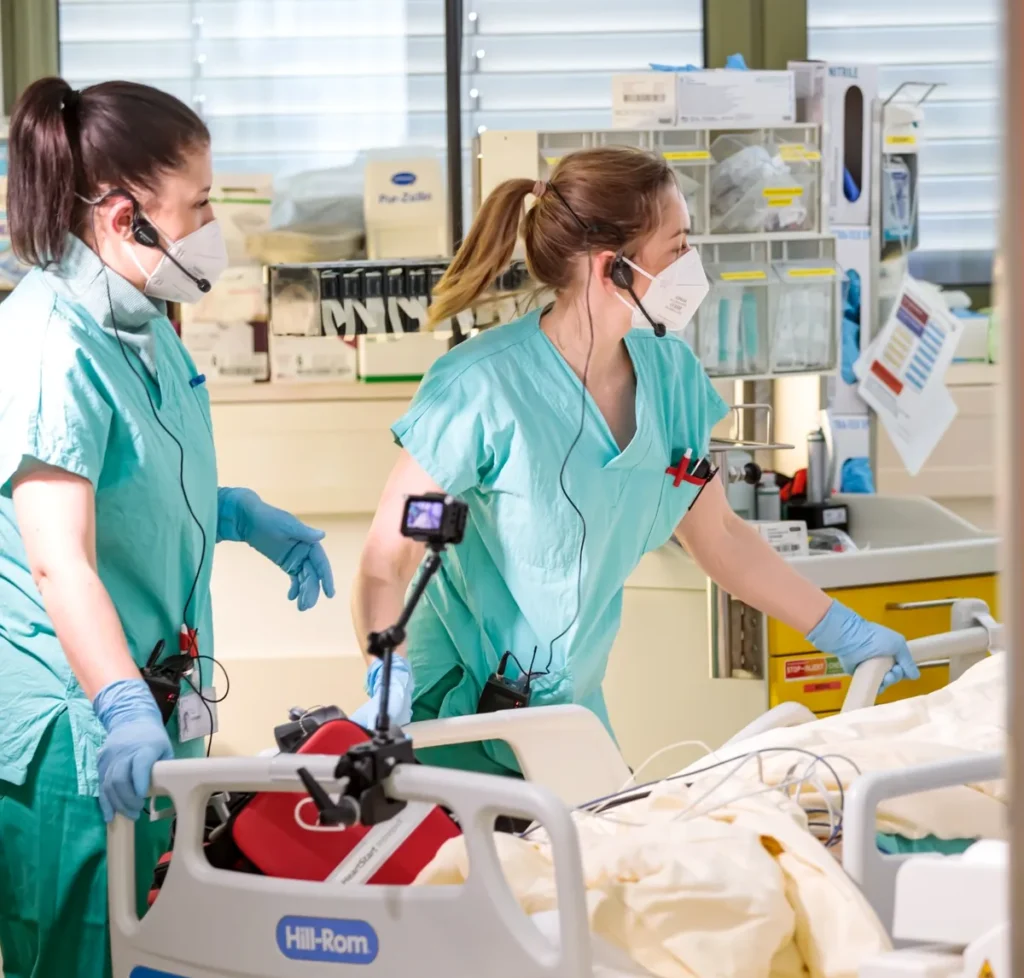
in situ simulation means running scenarios in the actual working environment, where care is delivered. Translational simulation goes further: its focus includes the changes that simulation can stimulate within the clinical system, alongside what individuals and teams learn.[5][6]
Simulation thus becomes a tool for organisational development. It goes beyond assessing knowledge or skills to reveal whether a system can function under realistic conditions.
Examples include alerting and escalation pathways; roles and task allocation; handovers between professions or departments; equipment availability and location; room layout, routes and sightlines; documentation and communication demands; interfaces between the emergency department, operating theatre, intensive care, diagnostics and wards; processes before go-live; and infrequent but critical clinical pathways.
International literature increasingly describes simulation as a method for identifying latent safety threats: risks already present in routine operations that often become visible only under pressure.[7][8] These include missing equipment, unclear responsibilities, impractical layouts, conflicting SOPs and information lost at handover.
Such risks rarely arise solely from individual misconduct. More often, they reflect a system that appeared workable during planning but was not tested sufficiently in practice.
Bridging the gap: Lean designs the process; simulation tests it in practice
Lean and simulation address different questions.
Lean asks: where is waste generated? Where do we lose time? Which steps do not add value? Where are unnecessary movement, waiting and duplicated work occurring? How can the workflow become more stable and efficient?
Simulation adds: does the workflow work under real conditions? Does everyone understand their role? Are equipment, spaces, communication and escalation workable? Which safety threats emerge only when the process is enacted? Which workshop assumptions fail in practice?
This combination matters to hospitals. Many process projects encounter difficulties in implementation rather than analysis. The process is documented, the SOP approved and the metric defined, yet workarounds, delays, misunderstandings and improvised solutions continue in daily clinical practice.
Simulation can bridge this gap by testing the planned process realistically before, during or after implementation. It complements Lean where conventional process improvement reaches its limits.
Lean makes processes visible. Simulation reveals whether those processes hold up in practice.
Why this matters to leaders and process owners
For leaders and process owners, this distinction has practical implications for patient safety, staff workload, implementation quality and confidence in investment decisions.
A newly designed resuscitation room may look functional on paper, until a scenario reveals that the ultrasound machine is in the way, medicines are unavailable where needed, or sightlines hinder team leadership and monitoring.
A new handover format may appear complete, until a simulated workflow shows that it takes too long under pressure, essential information is lost or concurrent tasks are left uncovered.
A discharge process may look convincing in a value-stream analysis, until a trial run reveals unclear responsibilities between the ward, doctors, nurses, social services, transport and administration.
A rare, high-risk scenario may be covered by an SOP, until simulation reveals uncertainty about who makes which decision, where specialist equipment is kept or how external support is called.
These findings can be uncomfortable, but they are valuable. Ideally, they emerge before patients are affected.
Patient safety requires work on the system
Austria’s Patient Safety Strategy 3.0 and international initiatives such as the WHO Global Patient Safety Action Plan 2021–2030 emphasise patient safety as a responsibility of the entire health system.[9][10] Safety depends on individual competence, reliable structures, well-designed processes, clear communication and a culture in which risks can be identified and addressed.
Lean helps organise processes and reduce waste. Simulation helps assess those processes from the perspective of actual care delivery. Together, they can help treat patient safety as a testable feature of clinical workflows, as well as an objective.
The approach matters: simulation should not be treated as an examination of individuals or a means of assigning blame. Its value lies in revealing system problems before an actual adverse event occurs.
Where simulation can support Lean projects
1. New or redesigned clinical areas
In new buildings, refurbishments and reorganisations, processes are often planned long before the first patient arrives. Simulation can serve as clinical systems testing: do routes, equipment positions, sightlines, alerting pathways and team positions actually work? Literature on simulation-based clinical systems testing describes this approach particularly for new care environments and clinical commissioning.[11]
2. Emergency departments, resuscitation rooms and acute care
Acute care involves time pressure, dense information and multiple interfaces. Lean can help structure flow, roles and standards. Simulation reveals whether these structures hold up in an emergency. Resuscitation and emergency scenarios make communication demands, concurrent tasks, equipment logistics, team leadership and interfaces visible very quickly.
3. Operating theatre workflows and turnaround times
Operating theatre processes are highly standardised, yet vulnerable to delays, interface problems and interdependencies between professions. One published example describes combining Lean methods and simulation to improve operating room turnover.[12] Such case reports do not replace broader outcome evidence, but illustrate how simulation can make process changes testable.
4. Discharge planning and patient flow
Lean projects addressing hospital throughput or discharge planning can improve process structure and reduce delays.[4] Simulation can complement this by testing critical handover points: who informs whom? What happens if a result is missing? When is transport arranged? Where do queries arise? Which tasks happen simultaneously?
5. Infrequent, high-risk situations
Some processes are infrequent but critical when needed: resuscitation, intrahospital transport of unstable patients, ECMO emergencies, major haemorrhage, paediatric emergencies and technical failures. Lean can establish standards; simulation can test whether teams can apply them in practice. Training frequency for such scenarios is discussed in our article How often should an emergency team train?.
Implementation: combining Lean and simulation effectively
Simulation needs a structured place within Lean projects if it is to deliver more than an isolated activity.
1. Select a critical process
Not every process needs simulation. Prioritise workflows involving high risk, complexity, multiple interfaces or substantial change, such as new care areas, emergency pathways, handovers, operating theatre processes or go-live situations.
2. Carry out the Lean analysis
First, understand the process: which steps are involved? Where do waiting, duplicated work, unnecessary movement and information loss occur? Which metrics matter? Which professions are involved?
3. Define the target process
The target process must be specific enough to test. General aims such as “better communication” are insufficient. Roles, triggers, escalation points, information routes and equipment arrangements need to be clear.
4. Plan a realistic simulation
The scenario does not need to be dramatic. It needs to represent the relevant process. Effective process simulations deliberately test the assumptions critical to safety and feasibility.
5. Debrief with a systems focus
Debriefing should extend beyond individual behaviour: what did the system enable or hinder? Where did participants have to improvise? Which information, spaces, equipment or responsibilities were unclear?
6. Define and follow up actions
A major mistake would be to let simulation end as an interesting experience. Each identified weakness needs ownership, prioritisation and follow-up. Without these, simulation cannot deliver its intended effect.
7. Test again
When substantial changes have been made, test the process again. This creates an improvement cycle that connects Lean and simulation in practice.
What should not be promised
An evidence-informed approach must acknowledge its limits.
Simulation does not guarantee that a process will remain reliable. It never fully reproduces reality, and its value depends strongly on scenario design, debriefing quality, organisational integration and follow-up. Lean is not a universal solution either. The literature reports positive effects on many process measures, but improvements in clinical outcomes or costs do not follow automatically from every intervention.[1][2]
Direct evidence for combining Lean and clinical in-situ simulation is also more limited than evidence for either approach separately. Relevant examples and a strong professional rationale exist, but they do not justify exaggerated claims of a “proven miracle combination”.[12][13]
This does not diminish the practical value. The complexity of implementing hospital process improvements makes methods that connect planning with reality particularly useful.
From process project to systems assessment
The change in perspective is this: simulation is part of process development itself, rather than simply the final training step after design is complete.
Its role shifts from isolated training towards testable systems development: from “we train the team” towards “we test whether our system supports the team”.
For leaders and process owners, this brings process improvement closer to actual care delivery. Alongside efficiency, the aim is to design workflows that teams can carry out safely under real pressure.
How this relates to Med-STA
This connection is central to Med-STA’s work: process improvement in healthcare extends beyond analysis. What matters is whether change reaches daily clinical practice.
With SimLean360° Lean Healthcare can be combined with simulation-based systems testing. The focus is on how real workflows, rooms, interfaces and team processes function under realistic conditions.
In addition, Consultancy & process improvement can help translate simulation findings into specific actions, priorities and implementation steps. Conventional simulation-based team training also remains important, particularly where teamwork, communication and rare critical events play a major role.
The professional boundaries should remain clear: simulation cannot replace leadership, process ownership or continuous improvement. It can, however, reveal where a process does not yet hold up within the actual system.
Conclusion
Lean is valuable in hospitals when it represents sustained work on clinical processes. Yet Lean alone cannot answer every question relevant to safe care.
A planned process is not yet a resilient process. An approved SOP is not yet a safe routine. A measured indicator does not automatically explain why a team needs to improvise.
Simulation helps bridge this gap by bringing process improvement into the real care environment: the actual room, team and interface.
Simulation therefore contributes a critical element to Lean Healthcare: it shows whether Lean processes are workable in hospital practice.
References
- Moraros J, Lemstra M, Nwankwo C. Lean interventions in healthcare: do they actually work? A systematic literature review. International Journal for Quality in Health Care. 2016;28(2):150–165. doi:10.1093/intqhc/mzv123
- Wang J, Lv H, Chen M, et al. A systematic review of lean implementation in hospitals: impact on efficiency, quality, cost, and satisfaction. International Journal of Health Policy and Management. 2025;14:8974. doi:10.34172/ijhpm.8974
- McCulloch P, Kreckler S, New S, et al. Effect of a „Lean“ intervention to improve safety processes and outcomes on a surgical emergency unit. BMJ. 2010;341:c5469. doi:10.1136/bmj.c5469
- Reineck LA, et al. Use of Lean Healthcare to Improve Hospital Throughput and Reduce Discharge Delays. Pediatric Quality & Safety. 2021. doi:10.1097/pq9.0000000000000473
- Brazil V. Translational simulation: not ‚where?‘ but ‚why?‘ A functional view of in situ simulation. Advances in Simulation. 2017;2:20. doi:10.1186/s41077-017-0052-3
- Nickson CP, Petrosoniak A, Barwick S, Brazil V. Translational simulation: from description to action. Advances in Simulation. 2021;6:6. doi:10.1186/s41077-021-00160-6
- Wetzel EA, Lang TR, Pendergrass TL, et al. Identification of latent safety threats using high-fidelity simulation-based training with multidisciplinary neonatology teams. The Joint Commission Journal on Quality and Patient Safety. 2013;39(6):268–273. doi:10.1016/S1553-7250(13)39037-0
- Lounsbury O, et al. The use of healthcare simulation to identify and address latent safety threats. Frontiers in Health Services. 2025. doi:10.3389/frhs.2025.1682629
- Bundesministerium für Soziales, Gesundheit, Pflege und Konsumentenschutz. Patient:innensicherheitsstrategie 3.0. 2025. [Patient Safety Strategy 3.0; German]
- World Health Organization. Global Patient Safety Action Plan 2021–2030. WHO, 2021. who.int
- Colman N, Doughty C, Arnold J, et al. Simulation-based clinical systems testing for healthcare spaces: from intake through implementation. Advances in Simulation. 2019;4:19. doi:10.1186/s41077-019-0108-7
- Meguerdichian M, Bajaj K, Pohlman J, et al. Novel combination of simulation and Lean methodology to improve operating room turnover. BMJ Simulation & Technology Enhanced Learning. 2017;3(2):75–76. doi:10.1136/bmjstel-2016-000175
- Tlapa D, Franco-Alucano I, Limon-Romero J, et al. Lean, Six Sigma, and Simulation: Evidence from Healthcare Interventions. Sustainability. 2022;14(24):16849. doi:10.3390/su142416849
- Diaz-Navarro C, Armstrong R, Charnetski M, et al. Global consensus statement on simulation-based practice in healthcare. Advances in Simulation. 2024;9:19. doi:10.1186/s41077-024-00288-1
- Davies E, Montagu A, Brazil V. Recommendations for embedding simulation in health services. Advances in Simulation. 2023;8:23. doi:10.1186/s41077-023-00262-3
Frequently asked questions about Lean and hospital simulation
Why is Lean alone not enough in hospitals?
Lean can analyse and improve processes. However, a process that works on a whiteboard may not hold up under real pressure. Simulation tests whether planned workflows function in the actual clinical system with real teams and equipment.
What is translational simulation?
An approach that focuses on changes within the clinical system as well as individual learning. Simulation is used to test processes, structures and interfaces and to stimulate organisational improvement.
When should simulation be used in a Lean project?
Before new processes go live, during new builds and refurbishments, at complex interfaces, for rare high-risk scenarios, or when an implemented process does not work as planned.
How does simulation for systems testing differ from simulation for training?
Systems testing focuses on whether equipment, spaces, roles, communication routes and workflows enable the team to work safely, rather than primarily assessing whether individuals perform correctly.
What is SimLean360°?
Med-STA’s approach combining Lean Healthcare with simulation-based systems testing. It examines whether real workflows, rooms, interfaces and team processes function under realistic conditions.