Author: Dr. Michael Weldi, MSc MBA, Managing Director, Med-STA GmbH
Why team communication is a clinical skill, and why resuscitation room teams need to practise where they work.
A resuscitation room is a demanding workplace. Information, decisions and procedures occur simultaneously. Ambulance clinicians, nurses, emergency physicians, anaesthetists, trauma surgeons, radiologists, theatre staff and intensive care teams may come together within minutes. Each brings expertise, yet the situation can quickly become difficult to coordinate.
This is where Crisis Resource Management (CRM) begins.
CRM describes the non-technical skills teams need in critical situations: leadership, communication, situational awareness, decision-making, resource management and teamwork.[1] Clinical expertise remains essential. Its reliable application during an emergency depends on coordination within the team.
Safety problems often arise through unclear roles, competing conversations, unconfirmed instructions, hierarchy, stress, noise, time pressure and a lack of shared routines, rather than a single individual.[2] These factors can be addressed through training in the actual resuscitation room, with the usual team, routes, equipment and disruptions.
Why resuscitation room communication matters to safety
Caring for a severely injured or acutely unstable patient requires a group of individuals to become a coordinated team quickly, alongside decisions about diagnosis and treatment.
Communication is part of care delivery.
An instruction that nobody accepts is not a completed task. A finding that is voiced but not heard cannot inform treatment. An unspoken concern may conceal an important warning. A handover disrupted by transfer, undressing and competing questions can lose essential information.
CRM and human factors literature has long described the influence of communication, team management and system factors on critical events in acute care, alongside clinical errors.[1] Gaba and colleagues brought Crisis Resource Management into medicine through anaesthesia.[3] Rall and Gaba helped establish the CRM principles used as practical guidance in German-speaking healthcare.[4] More recent German-language work, including Rall and Langewand, applies these principles to leadership and organisational responsibilities.[5]
The evidence needs careful interpretation. CRM training cannot easily be evaluated through a simple single-intervention, single-outcome model. Resuscitation rooms, teams and patients differ substantially. Reviews also acknowledge the difficulty of achieving Level IA evidence for this type of training.[2] Nevertheless, acute care safety depends on the system. Communication, training, implementation and local organisational conditions need to work together.[6][7]
The following five communication errors are common risks in resuscitation and emergency care and provide useful starting points for training, debriefing and process improvement.
1. Leadership is not visible
Formal clinical responsibility may be clear, but leadership is not always apparent to everyone in the room.
Problems arise when nobody leads, several people lead simultaneously, instructions come from different directions, or the leader makes clinical decisions without actively communicating, prioritising and seeking feedback.
Typical signs include competing instructions, duplicated or unfinished tasks, uncertainty about whom to update, and a leader so involved in individual procedures that the overall picture is lost.
CRM requires leadership to be recognisable.[5] It can begin with a simple statement:
“I am taking the team leader role.”
Then give brief, specific tasks to named people:
“Anna, please establish two large-bore IV lines and tell me when both are in place.”
“Thomas, please take blood for crossmatching and a blood gas sample.”
“Maria, please check CT availability and report directly back to me.”
Effective leaders communicate clearly, gather information, set priorities and create brief moments of orientation. This matters when blood pressure falls, an airway becomes critical, CT is delayed or theatre availability is uncertain.
The CRM principle of taking the leadership role or being a constructive, assertive team member has practical value here.[4] Leadership means maintaining oversight, while team members actively feed back relevant information.
2. General requests replace closed-loop communication
“Can someone prepare blood?”
“Please draw up adrenaline.”
“We need CT.”
These requests are risky when it is unclear who accepts the task, whether it was understood and whether it is complete.
Closed-loop communication is a simple, effective CRM tool.[1][8] Address a named person, specify the task, and obtain confirmation of acceptance and completion.
“Anna, please prepare 1 mg adrenaline for IV use and tell me when it is drawn up.”
“Understood. I am preparing 1 mg adrenaline for IV use.”
“The 1 mg adrenaline is drawn up.”
“Thank you. Do not give it yet.”
The apparent simplicity should not obscure its importance.
Video analyses of trauma team activations identify communication as a frequent area for improvement. Bhangu and colleagues highlighted incomplete closed-loop communication and parallel conversations.[8] These findings cannot be applied identically to every resuscitation room, but support a credible practical message: directed tasks and explicit feedback reduce ambiguity.
Closed-loop communication is particularly important for critical tasks involving medicines, blood products, airway management, defibrillation, alerting, CT or theatre coordination and handovers.
3. There is no shared picture of the situation
Different team members may each hold accurate information without sharing the same understanding of the situation.
Nurses know the latest observations. Ambulance clinicians know the mechanism of injury. Anaesthetists assess the airway. Trauma surgeons consider haemorrhage control. Radiology awaits the CT indication. The team leader needs to bring these perspectives together.
Without active sharing and summarising, people work from different pictures of reality.
A shared mental model and situational awareness need to be developed and refreshed deliberately.[1][4] This often takes only ten seconds.
“Brief pause: hypotensive patient after high-energy trauma, GCS 8, positive FAST, unstable pelvis. Priorities now: haemorrhage control, pelvic binder, transfusion protocol, and clarify theatre or intervention.”
Such team time-outs can prevent delays.
The CRM concept “10 seconds for 10 minutes” captures this: a brief pause can prevent several minutes of work in the wrong direction.[4] Situations change rapidly. A new finding, falling blood pressure or an airway complication may require reassessment of a decision that was appropriate two minutes earlier.
Team leaders need to facilitate the shared picture actively.
4. Important concerns remain unspoken
Warning signs often precede deterioration, but are not always voiced.
A nurse notices an unexpected medicine appearance. A junior doctor worries that airway risk is underestimated. An ambulance clinician holds additional information but finds no opportunity to speak. A radiographer sees an organisational problem others have missed.
Silence is understandable in hierarchical, noisy and time-critical situations, but can create risk.
CRM needs a culture in which concerns can be raised early and clearly.[5] Not every observation will be correct, but safety-relevant concerns need to be heard and assessed.
Clear escalation language can help:
“I am concerned because the blood pressure is still falling.”
“I see a safety issue: this blood product has not yet been clearly matched to the patient.”
“Please stop. I think we have two different medicine doses being discussed.”
“I need a decision: CT now or theatre first?”
These statements are safety tools.
Psychological safety develops before an emergency. A team that discourages everyday questions is unlikely to communicate openly during critical care. Leaders need to show that concerns are welcome, particularly from people with less status or experience, or from another profession.[5]
5. Handover is treated as a formality
Resuscitation room care often begins and ends with a handover.
Ambulance service to resuscitation room. Resuscitation room to CT, theatre or intensive care.
Each handover can be a safety barrier or a source of error.
Problems include handover during transfer, undressing and monitoring; questions from several people; lack of structure; no separation between reporting and questions; lost timings, medicines, allergies, mechanism or clinical trends; and unclear responsibility afterwards.
A good handover needs a brief, deliberately protected moment.
The team listens first and asks questions afterwards. One person leads the handover, another captures essential information, and critical points are repeated.
Consistency matters more than choosing between IMIST-AMBO, ATMIST, SBAR or a local structure. A framework needs practice in real workflows, beyond being written in an SOP.[9]
This illustrates the value of in-situ training. It tests whether handover works in the actual room: where does the ambulance team stand? Who listens and documents? When does transfer begin? Where do interruptions arise? Who decides when handover is complete?
Why checklists alone are insufficient
Checklists, algorithms and SOPs provide structure and reduce demands under stress, but need effective team communication.
A checklist cannot reveal a cramped room, a distant blood fridge, an unfamiliar radiology number, an inaudible leader or a nurse whose crucial observation goes unheard.
The resuscitation room is a working system, beyond its documented processes.
Teams need to apply CRM principles within that system: its routes, equipment, alerting pathways and the people who work together in actual emergencies.
The 2025 ERC Guidelines emphasise systems, education and implementation.[6] ILCOR’s Education, Implementation and Teams work also identifies knowledge transfer and implementation as distinct tasks.[7] A standard becomes effective when it functions locally.
What in-situ simulation reveals
Effective resuscitation room training makes workflows visible without assigning blame.
Realistic scenarios reveal leadership, communication, lost information, competing conversations, unconfirmed tasks, unclear interfaces, obstructed routes, inaccessible equipment and SOPs that do not fit actual spaces or staffing.
Debriefing turns those observations into shared learning.[10] Video-assisted debriefing supports analysis of specific events: what was clear or unclear? Where did the system support the team, and where did it hinder them?
The focus is on patterns rather than blame.
Effective CRM training combines repeated practice with reflection on communication, roles, priorities and system conditions.
Implications for resuscitation room teams
These five errors represent common risks in complex emergencies. They cannot be eliminated completely, but can become easier to recognise, discuss and manage.
This requires three levels of work.
First, shared language: teams need to understand closed-loop communication, team time-outs, shared situational awareness, escalation language and role clarity.
Second, repeated training: under stress, teams draw on practised patterns.[1]
Our article discusses how frequently those patterns should be refreshed: How often should an emergency team train?.
Third, local implementation: what works in a classroom needs testing in the actual resuscitation room.[9]
This is the professional rationale for “Train where you work”. External courses have value, while communication also depends on the particular space, equipment, routes, telephone systems, departments and hierarchies.
How this relates to Med-STA
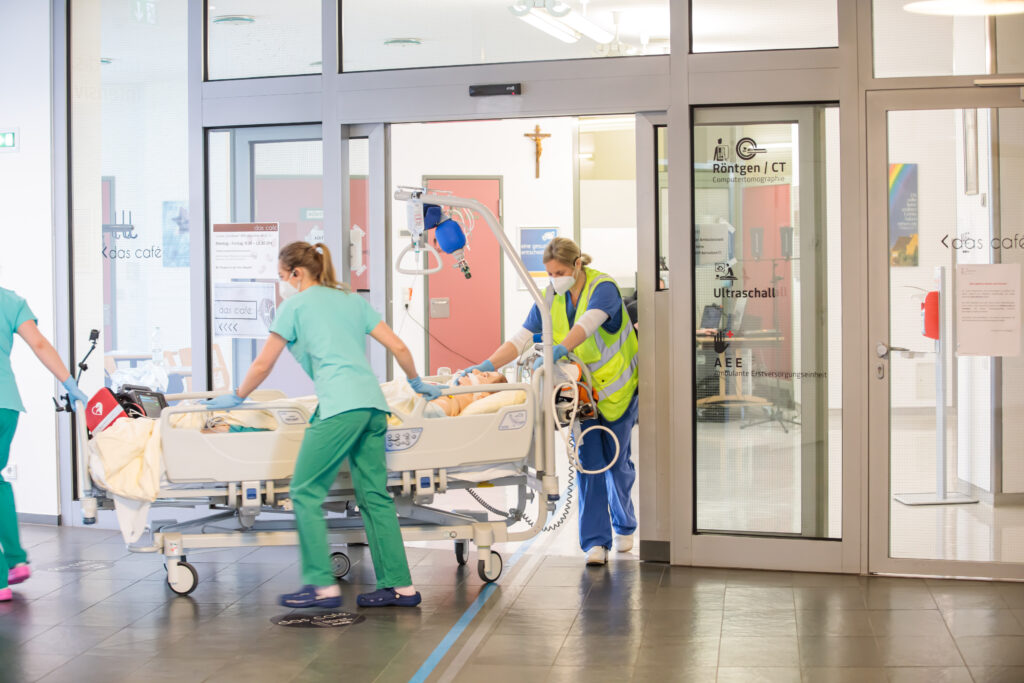
Med-STA delivers simulation-based team training and structured emergency response training in the actual working environment. Resuscitation room teams practise CRM through specific scenarios in their own setting and explore them during debriefing.
Our article compares in-situ simulation with simulation centre training and discusses when each format is useful: In-situ simulation or a simulation centre: choosing the right setting.
Our ECMO article explores applying these principles to ECMO teams: ECMO training: why technical skills alone are not enough.
Conclusion
CRM is a foundation of safe acute care.
Common communication errors involve small breaks in coordinated action: unclear leadership, an undirected request, an incomplete shared picture, an unspoken concern or a fragmented handover.
They create risk, and can be addressed through training.
Clear language, shared routines, repeated practice and a culture of open discussion help develop effective resuscitation room communication, in the setting where every minute matters.
References
- Burden AR, Cooper JB, Gaba DM. Crisis Resource Management and Patient Safety in Anesthesia Practice. In: Crisis Management in Anesthesiology. Oxford Medicine Online. 2016.
- Schild S, Sedlmayr B, Schumacher AK, et al. Crew Resource Management im Schockraum. [Crew Resource Management in the resuscitation room; German] Medizinische Klinik – Intensivmedizin und Notfallmedizin. 2021. doi:10.1007/s00063-021-00876-5
- Gaba DM, Fish KJ, Howard SK. Crisis Management in Anesthesiology. Elsevier.
- Rall M, Gaba DM. Human Performance and Patient Safety. In: Miller RD et al., eds. Miller’s Anesthesia. 7th ed. Philadelphia: Churchill Livingstone; 2009.
- Rall M, Langewand S. Die 15 CRM-Leitsätze für Führungskräfte. In: [The 15 CRM principles for leaders; German] Crew Resource Management für Führungskräfte im Gesundheitswesen [Crew Resource Management for healthcare leaders; German]. Springer. 2022. doi:10.1007/978-3-662-64564-4
- European Resuscitation Council. European Resuscitation Council Guidelines 2025: Systems Saving Lives. Resuscitation. 2025.
- International Liaison Committee on Resuscitation. Education, Implementation, and Teams: 2025 International Consensus on CPR and ECC Science. Circulation / Resuscitation. 2025.
- Bhangu A, Notario L, Pinto RL, et al. Closed loop communication in the trauma bay. Canadian Journal of Emergency Medicine. 2022;24(4):419–425. doi:10.1007/s43678-022-00295-z
- Rall M, Schmid K, Langewand S, Op Hey F. Crew Resource Management (CRM) für die Notaufnahme [Crew Resource Management for the emergency department; German]. Kohlhammer. 2020.
- INACSL Standards Committee. Healthcare Simulation Standards of Best Practice: Debriefing Process. Clinical Simulation in Nursing. 2021. doi:10.1016/j.ecns.2021.08.011