Author: Dr. Michael Weldi, MSc MBA
An emergency team is prepared when it can apply roles, workflows, communication and technical skills under realistic conditions, including at night, under time pressure, with changing staff and incomplete information. Previous course attendance alone is insufficient.
Hospitals, quality teams and leaders therefore face a practical question: how often should an emergency team train to turn education into reliable performance?
An annual course provides a useful foundation, but is usually insufficient on its own in high-risk areas. Current guidelines and studies increasingly support shorter, recurring refreshers, team training and simulation in the actual working environment.[1][2][3]
Why training frequency is a leadership responsibility
Hospital emergencies can be infrequent yet highly critical. Teams must make complex decisions, perform technical skills and communicate simultaneously. This applies to resuscitation, trauma and resuscitation room care, airway emergencies, perioperative crises, sepsis, haemorrhage, paediatric emergencies and acute obstetric situations.
Individual knowledge is insufficient. The team needs to function as a system: who leads, voices critical observations and documents events? Who coordinates medicines, defibrillation, the airway, relatives, interfaces and additional support? Who recognises when the planned workflow no longer fits reality?
E-learning alone cannot answer these questions. Teams need repeated, structured practice, as close as possible to their actual working environment.[4][5]
Competency deteriorates faster than organisations expect
Many hospitals use certificate validity as their reference point: complete the course and file the evidence. That may satisfy administrative documentation, but is too crude a measure of readiness.
Resuscitation education research has long described declining knowledge and skills after one-off courses. High-quality chest compressions, ventilation, defibrillation, airway management and structured communication do not remain reliable simply because they were once demonstrated correctly.[6][7]
Skills that are rarely used or practised become less dependable. During an emergency, this may appear as delays, unclear roles, interruptions, duplicated tasks or poor prioritisation.
What guidelines recommend
Current guidance extends beyond attending a course every few years. The 2025 ERC Guidelines emphasise education, regular practice, team competencies, feedback and simulation. For certain areas, training at least annually is explicitly recommended, preferably supplemented by more frequent short boosters, for example every three to six months.[1]
ILCOR and AHA resuscitation education recommendations also support recurring refreshers, spaced learning, feedback and simulation-based approaches.[2][3]
Research does not establish one universal frequency for every ward, hospital and emergency team. Resuscitation rooms, intensive care, endoscopy, general wards, maternity units and operating theatres have different risk profiles. Infrequent high-risk events nevertheless require planned maintenance of competency, beyond isolated mandatory courses.
Why annual training is often insufficient
An annual session is better than no structured training. It can establish standards, update algorithms and develop a shared foundation.
However, a single annual session has three limitations.
First, long gaps without feedback allow ineffective routines to develop unnoticed.
Second, conventional courses often take place away from the actual emergency setting, without its routes, devices, equipment locations, alerting pathways and team dynamics.
Third, team performance depends on context. A team may function well in a classroom yet struggle with room logistics, equipment searches, unclear roles and interfaces in practice.
This is why in situ simulation is increasingly important. It brings training to the workplace and tests spaces, processes, equipment, communication, alerting and handovers alongside individual performance.[4][8]
What studies show about training frequency
A randomised trial compared CPR training intervals of one, three, six and twelve months. Brief monthly training produced the best CPR skill quality after one year.[9] This does not mean every clinical emergency team needs a major simulation session each month. It does indicate that shorter, repeated practice can outperform an annual cycle.
Systematic reviews of skill retention following structured resuscitation training also identify simulation, refresher courses and training design as relevant approaches to maintaining competency.[6]
Evidence remains heterogeneous. One study found no clear benefit from particular booster timings and emphasised the importance of refresher content, quality and design, alongside timing.[10] More training is not automatically effective. It needs to be targeted, feedback-based and realistically planned.
ELSO offers specific frequency recommendations for ECMO teams. Read more in our article: ECMO training: why technical skills alone are not enough.
Team training involves more than CPR technique
Emergency training often focuses on algorithms, defibrillators, medicines, airway management and chest compressions. These remain essential, but need to be complemented by team skills.
Modern emergency care depends on teamwork. During resuscitation and resuscitation room care, risks arise through communication errors, unclear leadership, concurrent tasks, hierarchy-related barriers and missing feedback loops, as well as gaps in clinical knowledge.
Systematic reviews of team competencies in resuscitation education suggest that training in leadership, communication, decision-making and task management can improve team performance, although evidence quality remains heterogeneous.[5]
These non-technical factors matter because they influence whether knowledge can be applied during an emergency.
In-situ simulation: training and systems assessment
In-situ simulation assesses whether the system enables people to do the right thing in time, alongside whether they know what to do.
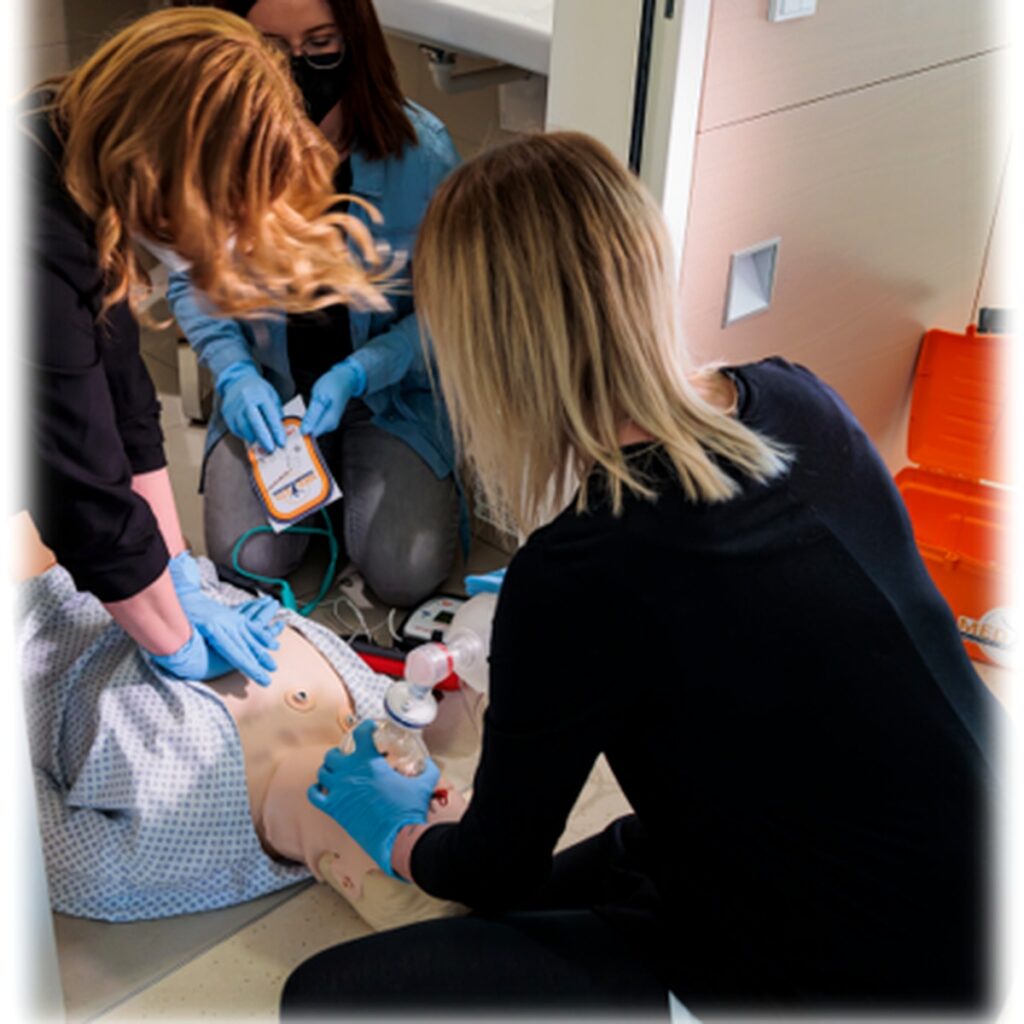
Training in the actual resuscitation room, intensive care unit or outpatient setting reveals whether equipment is where expected, alerting works, roles are clear, handovers structured, devices used safely, communication withstands stress and standards are workable.
A systematic review of in-situ CPR training reports generally positive effects on clinical performance, teamwork and CPR skills in simulated settings, while acknowledging heterogeneous evidence and unresolved questions about resources and cost-effectiveness.[4] For leaders, this balanced view matters: in-situ simulation needs clear objectives, professional facilitation and evaluation.
A practical model for hospitals
The evidence does not establish a rigid universal model, but supports a structured approach.
First, establish core training. All relevant professions need a shared foundation in algorithms, roles, technical skills, communication and teamwork. Suitable options include structured formats such as BLS, ILS and ALS and specialty-specific emergency training.
Second, provide brief recurring refreshers between major courses. Focus on individual topics such as high-quality chest compressions, defibrillator use, airway algorithms, medication logistics, roles, team leader communication or handover. Regularity matters more than session length alone.
Third, run recurring in-situ team training. High-risk areas should practise regularly in their own settings to test processes, interfaces and safety barriers alongside skills. This is particularly relevant to resuscitation rooms, intensive care, operating theatres, recovery, endoscopy, emergency departments, maternity and paediatrics.
The launch phase is particularly important for primary care units. Our article explores treating it as a safety project: Launching a primary care centre safely: lessons from the Austrian Patient Safety Award 2025.
The practical objective is a recurring, risk-adapted training system for every relevant emergency team, rather than annual course attendance alone.
What decision-makers should take from this
For medical directors, nursing directors and quality teams, the question is whether training matches the risks.
Areas with infrequent but potentially fatal events need different training intervals from settings with frequent emergency exposure. New teams, high turnover, new infrastructure, new SOPs and recurring incidents all indicate a need to review frequency and format.
Training belongs within a broader safety approach: clear standards, regular exercises, structured debriefings, measurable quality indicators, organisational feedback loops and specific process improvements following training or real events.
Treating training solely as continuing education underestimates its value. Effective emergency training contributes to organisational development.
Our article describes incorporating simulation-based systems testing into Lean projects: Lean in hospitals: why simulation is the missing component.
Conclusion
The evidence provides sufficient direction for action: an annual course can be an important foundation, but is not a complete approach to maintaining clinical emergency competence.
Emergency teams need repeated practice, feedback, realistic scenarios and training where they actually work. Frequency should be planned according to risk, within a system of continuous competency maintenance.
Certificates alone do not ensure readiness. Teams need repeated, realistic training where emergencies occur.
Med-STA in practice
Med-STA supports hospitals in embedding emergency competence in daily work through structured emergency response training based on ERC standards, simulation-based in-situ team training, video-assisted debriefing and process analysis in the real setting.
The approach follows a simple principle: Train where you work. Our article compares in-situ simulation with simulation centre training: In-situ simulation or a simulation centre: choosing the right setting. Our article on communication explores the errors that training commonly reveals: CRM in emergency medicine: five common communication errors in the resuscitation room.
References
- European Resuscitation Council. European Resuscitation Council Guidelines 2025: Executive Summary. Resuscitation. 2025.
- European Resuscitation Council. European Resuscitation Council Guidelines 2025: Education for Resuscitation. Resuscitation. 2025.
- American Heart Association. Part 12: Resuscitation Education Science: 2025 American Heart Association Guidelines for CPR and ECC. Circulation. 2025.
- Cortegiani A, et al. In situ simulation for cardiopulmonary resuscitation training: A systematic review. Resuscitation Plus. 2024. doi:10.1016/j.resplu.2024.100595
- Greif R, et al. / ILCOR EIT Task Force. Teaching team competencies within resuscitation training: A systematic review. Resuscitation Plus. 2024. doi:10.1016/j.resplu.2024.100603
- Au K, et al. Improving skills retention after advanced structured resuscitation training: A systematic review of randomized controlled trials. Resuscitation. 2019;138:284–296. doi:10.1016/j.resuscitation.2019.03.031
- Yang CW, et al. A systematic review of retention of adult advanced life support knowledge and skills in healthcare providers. Resuscitation. 2012;83(9):1055–1060. doi:10.1016/j.resuscitation.2012.02.027
- International Liaison Committee on Resuscitation. Education, Implementation, and Teams: 2025 International Consensus on CPR and ECC Science. Circulation / Resuscitation. 2025.
- Anderson R, et al. Optimal training frequency for acquisition and retention of high-quality CPR skills: A randomized trial. Resuscitation. 2019;135:153–161. doi:10.1016/j.resuscitation.2018.11.024
- Waldolf R, et al. The timing of booster sessions may not improve resuscitation skill retention among healthcare providers: a randomized controlled trial. Canadian Medical Education Journal. 2023. doi:10.36834/cmej.76568