Author: Dr. Michael Weldi, Med-STA GmbH
ECMO is infrequent. That contributes to its risk.
The challenge is not unfamiliarity with the technique, or a lack of knowledge among intensivists, surgeons, perfusionists and critical care nurses. A procedure used infrequently, under intense time pressure, with complex equipment and changing interdisciplinary teams can rarely become purely routine.
The challenge extends beyond cannulation, circuit management or individual device settings. Teams must think, act, communicate and prioritise together under stress. This is where a collection of experts becomes an expert team.
For ECMO education, technical skills remain essential, but are insufficient alone. Contemporary programmes need to integrate cognitive, psychomotor and behavioural competencies. The current ELSO guideline on ECMO training and continuing education explicitly describes a competency-based approach combining knowledge, technical skills, simulation, debriefing, assessment and team behaviour.[1]
ECMO is a high-risk system, not a stand-alone procedure
ECMO involves an entire clinical system, as well as a device.
It includes determining indications, patient selection, cannulation, imaging, anticoagulation, ventilation, haemodynamic management, laboratory testing, transport decisions, equipment logistics, roles, escalation pathways and ongoing management of potentially life-threatening complications. ELSO emphasises competencies in patient selection, circuit and patient management, troubleshooting and emergency response among practitioners from different professions and roles.[1]
One person may place a cannula correctly, another understand the circuit and a third interpret cardiovascular physiology. Patient safety depends on bringing those individual competencies into coordinated action.
Technical skills are essential
Technical training is the foundation. An ECMO team cannot work safely without competent cannulation and circuit handling, and an understanding of pump flow, sweep gas, oxygenator function, pressures, alarms and anticoagulation.
For psychomotor skills, the ELSO guideline recommends structured hands-on training, deliberate practice, direct feedback and realistic simulation. Simulation can begin with repetitive practice of defined tasks such as de-airing, circuit drills and emergency procedures. Once the foundations are established, complexity should increase through time pressure, distractions and more realistic decision-making demands.[1]
This is educationally sound. Individual actions need to be sufficiently well practised to remain available under stress. However, technical training alone has limits.
Where ECMO errors arise in practice
Many critical ECMO situations involve technical, communication and organisational challenges simultaneously.
The ELSO VA-ECMO guideline describes complications as common and potentially life-threatening: bleeding, cannula malposition, distal ischaemia, circuit thrombosis, oxygenator problems, haemolysis, infection, differential oxygenation, left ventricular distension and neurological complications.[2] During VV-ECMO, recirculation and hypoxaemia are among the clinically relevant problems. Hypoxaemia can have multiple causes, including recirculation, sepsis, fever, agitation, movement and shivering.[3]
Training therefore needs to help teams recognise what is happening, establish who holds relevant information, identify who leads decisions and communicate the next steps clearly. In high-risk situations, a correct idea must be spoken, understood, confirmed and acted upon.
Why separate training models have limitations
Many education formats address technical and team skills separately. This is understandable, but reflects reality only to a limited extent.
A technically focused format can train cannulation, device configuration and individual circuit problems well. It usually captures role conflicts, concurrent tasks, decision pressure, changes in leadership, equipment logistics and communication breakdowns less fully.
A stand-alone CRM or non-technical skills format can teach shared language, roles and decision-making principles. Without a genuine technical challenge, however, it can remain abstract. Teams discuss communication without experiencing the cognitive demands under which communication may fail.
Comparing training approaches
| Training approach | Learning objectives | Typical methods | Evidence base | Advantages |
|---|---|---|---|---|
| Technical skills only | Cannulation, circuit handling, de-airing, device management and recognition of individual technical faults | Skills stations, task trainers, deliberate practice and device drills | Well supported for psychomotor skills. ELSO recommends deliberate practice and cites improved cannulation performance. Insufficient on its own for team behaviour. | Repeatable, readily standardised and suited to targeted feedback |
| Non-technical skills only | Communication, leadership, closed-loop communication, role allocation and CRM | CRM teaching, tabletop exercises, communication micro-drills and case discussions | Professionally credible and relevant to team behaviour, but supported by a more limited ECMO-specific evidence base than integrated or high-fidelity formats. ELSO calls for team training in a high-fidelity context. | Accessible, supporting shared language and teamwork principles |
| Integrated simulation | Concurrent practice of indication assessment, cannulation, troubleshooting, communication, leadership and systems testing | High-fidelity simulation, interdisciplinary scenarios, real equipment, and briefing–simulation–debriefing–assessment | Recommended by ELSO within minimum training standards. A review of 28 studies reported consistent improvements in competency, communication, troubleshooting and time to critical actions, within a heterogeneous evidence base. | High realism; practice of actual coordination; process and team assessment in the same setting |
This table synthesises the literature. Direct head-to-head comparisons of all three approaches using patient-relevant outcomes remain insufficient. The strongest recommendation is for an appropriate combination, with emphasis on integrated, structured high-fidelity simulation.[1]
The current ELSO training guideline supports this integrated view. It describes high-fidelity simulation as an important tool for team communication, Crisis Resource Management, leadership and managing ECMO emergencies.[1]
What effective ECMO training needs to achieve
ECMO training should assess whether the team functions as a system, alongside individual technical competence.
The ELSO guideline describes four phases for high-fidelity ECMO simulation: briefing, simulation, debriefing and assessment. Briefing establishes objectives, roles, equipment and psychological safety. Simulation presents a realistic ECMO scenario. Debriefing explores actions, communication and decisions. Assessment considers whether defined competencies have been achieved.[1]
Recommended training components
| Component | Frequency | Duration | Learning objectives |
|---|---|---|---|
| Foundation module covering indications, contraindications, modalities, physiology and complications | At onboarding and after substantial protocol changes | The ECMO literature does not establish sufficiently standardised durations in minutes | Shared mental model for indications, VA/VV modalities, anticoagulation and common complications |
| Technical drills covering cannulation, circuit handling and emergency recognition | Quarterly | Insufficiently standardised; allow adequate time for repeated practice | Safe fundamental technical actions, fault recognition and reliable responses |
| Combined technical and team-performance scenario | Twice a year | Insufficiently standardised; include briefing, simulation, debriefing and assessment | Integrating technical skills, communication, leadership, task allocation and troubleshooting |
| Multidisciplinary team training with systems testing | Annually | Set locally; no adequately established standard duration | Testing roles, alerting pathways, logistics, equipment availability, interfaces and process gaps |
| Debriefing after every scenario | After every session | An essential component; duration is not sufficiently standardised | Reflection, connecting actions with outcomes, team learning and changes in practice |
| Recertification or reactivation following inactivity | Following an extended period without exposure; an older ELSO centre guideline identifies more than 3 months without pump management as a trigger | Define locally | Preventing loss of competency where exposure is limited |
Training components based on the current ELSO educational approach, adapted for the clinical training context.[1]
ELSO offers pragmatic guidance on frequency. The guideline also notes that skills may decline within six months without reinforcement and that low-volume centres need more frequent hands-on training.[1] Our article explains how this can fit within a broader emergency team training programme: How often should an emergency team train?.
What integrated simulation changes
Integrated ECMO simulation brings together the elements that occur simultaneously in an emergency: technical procedures, complex physiology, real device and monitor behaviour, ventilation and oxygenation problems, time pressure, uncertainty, interprofessional communication, decisions and escalation.
It reveals questions that conventional training often leaves hidden: who leads? Who voices critical changes? Who prioritises? Who confirms decisions? Who recognises when a technical problem has become a team or process problem?
Our article discusses how in situ simulation compares with simulation centre training, and when each format is useful.
What matters in debriefing
Debriefing goes beyond asking “what went well and what went badly?” It is the central learning phase.
ELSO describes debriefing as a critical phase in which participants reflect on performance, analyse key actions and receive structured feedback. The reasoning behind an outcome matters: why was information missed? Why was a warning left unspoken? Why was a role unclear? Why was escalation delayed?[1]
For ECMO teams, debriefing should examine at least four levels: clinical reasoning about indications and complications; technical use of cannulation, circuit, monitoring and device information; team roles, communication, leadership and escalation; and system performance involving equipment, space, alerting, interfaces and processes.
The systems level is often underestimated. Training can be valuable even when everyone works competently but the process reveals missing equipment, unclear alerting, undefined responsibilities, spatial constraints or conflicting local standards.
What can usefully be measured
Direct effects of simulation on patient outcomes are difficult to establish. ECMO events are infrequent, patient populations heterogeneous and training interventions varied. Nevertheless, studies and guideline frameworks indicate improvements in competencies, communication, troubleshooting and preparedness. The precise size of the clinical effect cannot be quantified reliably in every setting.[1]
Training should therefore use realistic process and competency indicators: time to an ECMO decision and first flow, technical errors, use of closed-loop communication, role clarity and task allocation, equipment availability, room logistics and specific post-training action lists.
These indicators do not replace clinical outcomes. They can show whether training supports clearer workflows and better coordination.
What the evidence cannot establish
A responsible discussion must acknowledge the limitations.
Current literature supports competency-based ECMO education, high-fidelity simulation, team training, structured debriefing and continuing refreshers. However, many ECMO simulation studies are small, heterogeneous, single-centre studies that are difficult to compare directly. Evidence of hard patient outcomes for individual training formats remains limited.[1]
This does not mean training is ineffective. It does mean that exaggerated promises should be avoided. ECMO simulation does not guarantee error-free care. It creates opportunities to practise rare, complex, high-risk situations repeatedly, systematically and safely before they occur in a real patient.
In a high-risk setting, this is professional preparation.
How this relates to Med-STA
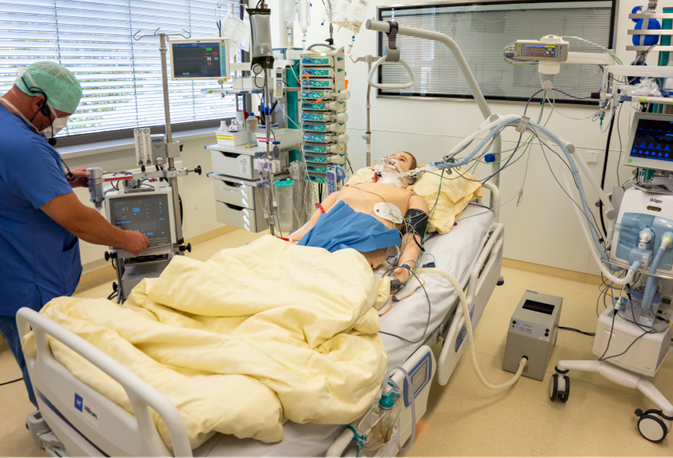
Med-STA has developed SIMLUTIONS® as an ECMO simulator that combines technical skills and team training within one scenario: venous and arterial circuits for VA- and VV-ECMO, cannulation using real materials, high-fidelity patient simulation, integrated ultrasound, real monitoring, lung simulation, realistic ventilation abnormalities and SimBGA for simulated laboratory results.
The ECMO simulation-based team training combines indication assessment, cannulation, VA-/VV-ECMO, complication management and team communication under high stress. Technical and communication skills are practised simultaneously, reflecting their interaction in an emergency.
Conclusion: ECMO safety depends on teamwork
ECMO training needs to extend beyond technology.
Cannulation, device competence and troubleshooting remain essential. ECMO is an interdisciplinary high-risk process in which communication, leadership, role clarity, decision-making and systems testing matter alongside safe management of cannulas and circuits.
Technical skills alone are insufficient because an emergency involves clinical, technical, communication and organisational challenges at the same time.
Effective ECMO training needs to reflect this simultaneity. Integrated simulation reveals whether individual experts can function as a coordinated expert team. Patient safety depends on knowing what to do and being able to do it together at the right moment.
References
- Moore EA, Han P, Shekar K, Ramanathan K, Riera del Brio J, Puslecki M, et al. ELSO 2025 Narrative Guideline on ECMO Training and Continuing Education. ASAIO Journal. 2026;72:274–283. doi:10.1097/MAT.0000000000002686
- Lorusso R, Shekar K, MacLaren G, et al. ELSO Interim Guidelines for Venoarterial Extracorporeal Membrane Oxygenation in Adult Cardiac Patients. ASAIO Journal. 2021. elso.org
- Tonna JE, Abrams D, Brodie D, et al. Management of Adult Patients Supported with Venovenous Extracorporeal Membrane Oxygenation: Guideline from ELSO. ASAIO Journal. 2021. elso.org
- DellaVolpe J, Barbaro RP, Cannon JW, Fan E, Greene WR, et al. Joint SCCM–ELSO Task Force Position Paper on the Role of the Intensivist in the Initiation and Management of ECMO. Critical Care Medicine. 2020;48(6):838–846.
- Extracorporeal Life Support Organization. ELSO Guidelines – overview. elso.org
- Extracorporeal Life Support Organization. ELSO Education. elso.org
- Extracorporeal Life Support Organization. Guidelines for ECMO Centers. Version 1.8, 2014. elso.org
- Extracorporeal Life Support Organization. Adult and Pediatric Anticoagulation Guidelines. 2022. elso.org
Frequently asked questions about ECMO training
Why is technical ECMO training alone insufficient?
ECMO complications rarely involve technical issues alone. Teams must decide, communicate and act simultaneously under time pressure. Technical competence is the foundation, complemented by communication, clear roles and shared decision-making.
What does the ELSO 2025 guideline suggest about training frequency?
Quarterly practice of psychomotor skills and emergency recognition, combined technical and team training twice a year, and annual multidisciplinary team training with systems testing. Low-volume centres need more frequent training.
What is integrated ECMO simulation?
Training that combines cannulation, device management, complication management, decision-making and team communication within the same scenario, rather than teaching technical and non-technical skills separately.
What role does debriefing play in ECMO training?
Debriefing is the central learning phase. It explores outcomes and the reasoning behind them: why was information missed, a warning not voiced or a role unclear?
How effective is ECMO simulation according to the evidence?
Studies report improvements in competencies, communication and troubleshooting. Evidence of hard patient outcomes is limited. ELSO nevertheless recommends high-fidelity simulation as an important tool in ECMO education.