Author: Dr. Christian Pizzera, Medical Director, Med-STA GmbH
A patient collapses in the waiting area. A child has a febrile seizure. Someone develops a severe allergic reaction after an injection. Such events are infrequent in medical practices, but when they occur, teams need to act immediately.
Clinical knowledge is only part of the response. Who leads? Where is the defibrillator? Who calls the ambulance service? Who looks after other patients in the waiting area? These questions need answers before an emergency occurs.
Why medical practices are particularly vulnerable
Medical practices are not emergency departments or intensive care units, yet acute breathlessness, anaphylaxis and cardiac arrest can occur regardless of specialty or time of day. The 2025 ERC Guidelines address emergencies outside hospital, where conditions differ.[1]
Small teams, limited emergency exposure, continuing appointments and restricted space complicate the response. Patients are waiting and the telephone continues ringing. An emergency disrupts routine clinically and emotionally.
The whole team needs to know how and when to act; knowledge held by the doctor alone is insufficient.
Equipment alone does not ensure safety
Many practices have an emergency bag, defibrillator and oxygen. Does everyone know their locations? Can each team member switch on the defibrillator without hesitation? Who retrieves it, and who starts chest compressions in the meantime?
Kalidindi and colleagues studied 20 practices. Self-reported emergency preparedness increased from 2.95 out of 5 before in-situ simulation to 4.02 afterwards. This highlights scope to improve preparedness alongside equipment provision; it is a self-reported measure, rather than proof of improved patient outcomes.[2]
Practices should regularly check whether equipment is complete and working, everyone knows its location, space is available for resuscitation and ambulance access has been clarified.
In our experience, substantial improvements often involve straightforward organisational details.
What makes a difference in an emergency
Training cannot remove stress, but can help teams act more effectively under pressure through clear, repeatable workflows.
A prepared team knows who leads, provides basic interventions, makes the emergency call, prepares equipment and hands over to the ambulance service.
Communication is often underestimated. Unclear instructions and missing feedback can contribute to emergency errors. Bhangu and colleagues identified communication as the lowest-rated competency in trauma teams, below situational awareness and decision-making. Directed, closed-loop communication supports task completion.[3]
For example, replace “Can someone get the defibrillator?” with “Anna, please bring the defibrillator from the laboratory now and tell me when you are back.”
A small change in wording can make a substantial difference.
Why education alone is insufficient
Lectures and guidelines provide the foundation. Emergencies, however, occur in the consulting room, between reception and the medicine cupboard.
Can resuscitation be performed on the examination couch? How long does it take to prepare oxygen? Who looks after waiting patients? These practical questions need testing in the workplace.
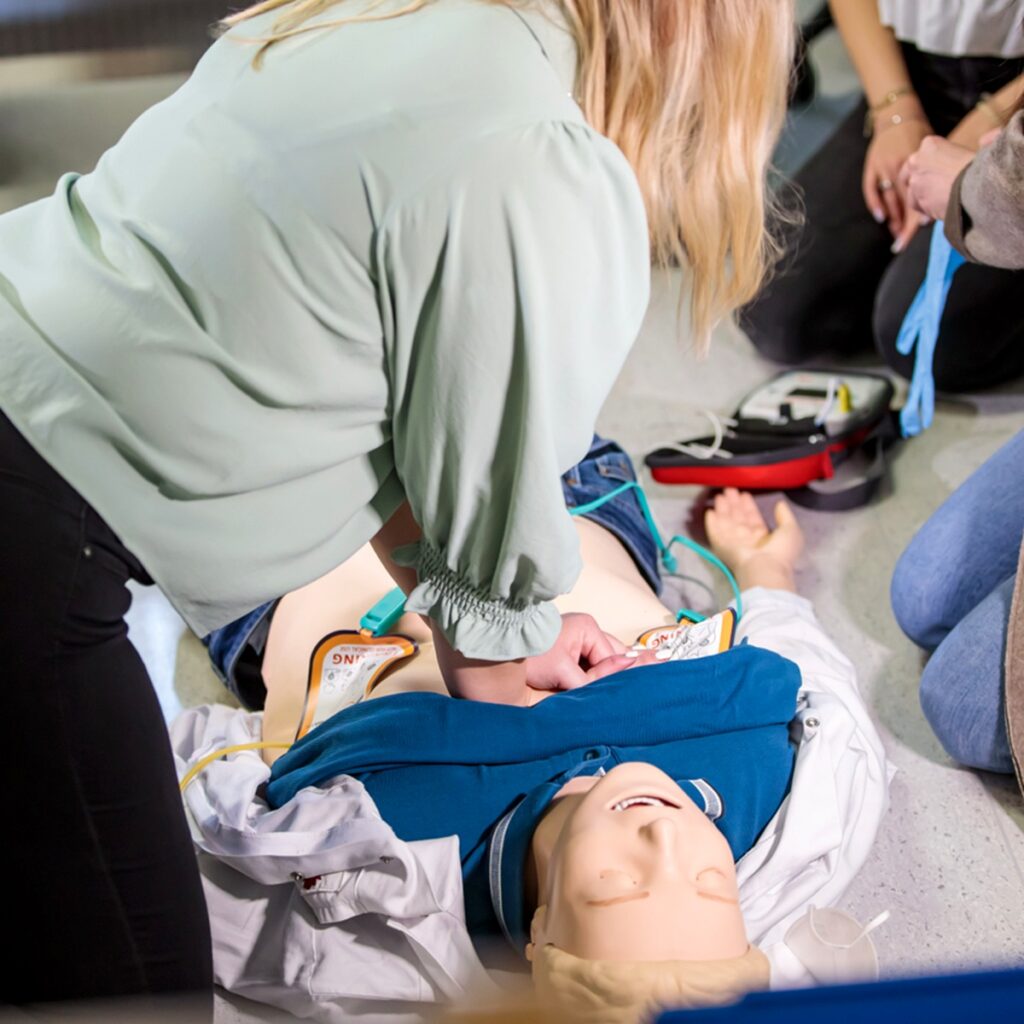
Effective training therefore takes place directly in the practice, using in situ simulation, with the actual team, premises and equipment. It reflects the conditions in which the team must respond.
Turning the experience into improvement
Debriefing is often the most important part of training. Structured discussion reveals what worked and where uncertainty remained.
Levett-Jones and Lapkin’s systematic review identifies debriefing as an essential component of simulation-based education, connecting experience with learning.[4] The INACSL Healthcare Simulation Standards of Best Practice recommend structured debriefing as an integral component of simulation-based education.[5]
Many changes can be implemented immediately: relocating the emergency bag, clarifying roles, adding a reception checklist or assigning equipment checks. These steps help turn training into practical patient safety improvement.
Preparation supports confident action
A prepared team can respond more calmly because the next steps are clear, even when the emergency remains serious.
Patients can receive help sooner, teams feel less helpless and practice leaders gain greater organisational clarity.
Emergency preparation needs to fit the premises and be practised together. A practical training day can be more useful than an emergency folder that nobody consults.
In an emergency, teams need to know their workflows as well as the theory.
Med-STA delivers emergency training in your medical practice — tailored to your team, premises and needs. → Explore emergency training for medical practices | → Get in touch
References
- Lott C, Karageorgos V, Abelairas-Gomez C, et al. European Resuscitation Council Guidelines 2025: Special Circumstances in Resuscitation. Resuscitation. 2025;215:110753. doi:10.1016/j.resuscitation.2025.110753
- Kalidindi S, Kirk M, Griffith E. In-Situ Simulation Enhances Emergency Preparedness in Pediatric Care Practices. Cureus. 2018;10(10):e3389. doi:10.7759/cureus.3389
- Bhangu A, Notario L, Pinto RL, et al. Closed loop communication in the trauma bay: identifying opportunities for team performance improvement through a video review analysis. Can J Emerg Med. 2022;24:419–425. doi:10.1007/s43678-022-00295-z
- Levett-Jones T, Lapkin S. A systematic review of the effectiveness of simulation debriefing in health professional education. Nurse Education Today. 2014;34(6):e58–e63. doi:10.1016/j.nedt.2013.09.020
- INACSL Standards Committee. Healthcare Simulation Standards of Best Practice: The Debriefing Process. Clinical Simulation in Nursing. 2021;58:27–32. doi:10.1016/j.ecns.2021.08.011